Wrestling · Careers
How to build a wrestling career in Nigeria
From village contests to Olympic silver: every step, how wrestlers really support themselves, scholarships, safety rules and advice from Nigerian champions.
Advertisement
Careers in wrestling
Your road to the national team
Long before Nigeria had a wrestling federation, wrestling was already here: at village festivals, on riverside sand in the Niger Delta, among Igbo and Yoruba youths testing their strength. Today that tradition has made Nigeria Africa's wrestling powerhouse, with an Olympic silver medal, 49 Commonwealth Games medals and a cabinet full of African titles.
This page is written for young wrestlers, parents, teachers and coaches. It explains each stage from your first bout to the national team, how Nigerian wrestlers actually support themselves, the scholarships that wrestling has opened in the United States, the careers around the mat, and the rules that keep young wrestlers safe. Every fact was checked on 1 October 2026.
One honest truth before you start: Olympic-style wrestling in Nigeria is not a salaried profession. We could find no published salaries for Nigerian wrestlers. What wrestling does offer, more than almost any Nigerian sport, is a real chance to win medals for your country, especially for girls, plus travel, education and a lifelong career as a coach or official.
Career facts · Checked 1 October 2026
Nigerian wrestling careers in numbers
-
49
Commonwealth medals
12 of them gold, Nigeria's record in Commonwealth Games wrestling.
-
2020
Olympic silver
Blessing Oborududu, women's freestyle 68 kg, Tokyo.
-
4
Free coaching levels
UWW's Coach's Education Pathway, from Foundation to Master Coach.
-
₦25,000
Allowance per wrestler
Every registered athlete at the 2026 Governor Diri Wrestling Classics.
The pathway at a glance
Six stages from first bout to the world stage
Ages are a guide, not a rule. Blessing Oborududu started in secondary school and won Olympic silver at 32.
Age 6 to 12
Traditional and playground wrestling
In wrestling communities children grapple from an early age. Learn to fall, to balance and to respect your opponent.
Age 12 to 17
School team or wrestling club
Blessing Oborududu started in secondary school. Find a club or centre with a qualified coach, such as those in Bayelsa, Ondo or Anambra.
Age 14 to 20
State team and national competitions
State officials pick wrestlers for the National Sports Festival and national tournaments such as the Governor Diri Wrestling Classics.
Age 15 to 20
Cadet and junior championships
Cadet and junior events come first. Stephen Akintewe, 16, of Akure High School won cadet gold at the 2018 African Championships.
Age 18 and up
Senior national team
African Championships, Commonwealth Games, World Championships and the Olympics. Nigeria won the African team title in 2026.
Age 18 and up
Scholarships, coaching and beyond
Nigerian wrestlers have won US college scholarships, and retired champions coach, referee and lead the sport.
Step by step
Eight steps to a wrestling career
Follow these in order. Each step builds on the one before it.
Start where wrestling already lives
Wrestling is part of Nigerian culture. Daniel Igali, the Bayelsa-born 2000 Olympic champion, grew up wrestling as part of his Ijaw culture, where, he says, everybody wrestles because the community lives close to the sea. Whether your first bouts were at a village festival or in the school field, that is a real foundation.
- Join your school's sports or wrestling team, and take part in inter-house sports.
- Ask your games teacher whether your state runs school or youth wrestling competitions.
- Practise the basics: stance, footwork, falling safely and bridging.
Find a qualified coach and a proper mat
Traditional wrestling builds strength; Olympic wrestling needs technique. Train on a proper mat with a coach who knows the rules of United World Wrestling (UWW), the world governing body. Nigeria now has its own highly qualified coaches: in October 2023 UWW ran a pilot Level 3 coaching course at the national wrestling centre in Yenagoa, Bayelsa State, and 18 of the 21 participants completed it.
Clubs and centres have produced Nigeria's champions. Igali founded the Dynamite Wrestling Centre in 2012, and the Hardcore Wrestling Academy in Onitsha was set up to train young wrestlers under the federation. Bayelsa and Ondo States have produced many of Nigeria's champions. Read their stories on our Nigerian wrestlers page.
Choose your style and a healthy weight class
Olympic wrestling has three styles: men's freestyle, Greco-Roman and women's wrestling. Nigeria's greatest successes have come in freestyle, especially women's freestyle. There is also beach wrestling, wrestling on sand, which is on the programme of the Dakar 2026 Youth Olympic Games.
Wrestlers compete in weight categories. Under UWW rules, wrestlers weigh in on the morning of competition, with a two-kilo allowance on the second day, a format introduced in 2017 to limit extreme weight loss. Choose the category your body naturally fits, with your coach's advice, rather than starving yourself to drop a class.
Get picked for your state
State teams are the doorway to national recognition. Blessing Oborududu's talent in secondary school caught the attention of Bayelsa State officials, who invited her to the National Sports Festival; two years later she had a permanent place on the national team. She made her first Festival appearance in 2006 and, fittingly, retired at the National Sports Festival in Abeokuta with one last gold medal.
Train hard, attend every state trial and ask your coach to register you for state selection.
Shine at national tournaments
National tournaments are where federation coaches look for talent. The 4th Governor Douye Diri Wrestling Classics in Yenagoa in March 2026 drew teams from 21 states; the federation fed every registered athlete, paid each one an allowance of ₦25,000, gave cash prizes to medallists and supported teams' travel. Federation president Dr. Bashir Adewale Adeniyi promised more national tournaments through the year. Strong results at national events are how wrestlers get noticed by the federation's coaches.
Represent Nigeria in Africa and beyond
Nigeria's national team is one of the strongest in Africa. It won the team title at the 2026 African Championships in Alexandria, Egypt, with 9 gold, 4 silver and 3 bronze medals, and its women swept all six freestyle golds at the 2023 African Games in Accra in March 2024. From Africa the road leads to the Commonwealth Games, where Nigeria has won 49 wrestling medals, the World Championships, where Odunayo Adekuoroye has won four medals, and the Olympics, where Blessing Oborududu won silver at Tokyo 2020. See our Olympics and Games page for every result.
Use wrestling to earn an education
Wrestling is a major college sport in the United States, and Nigerian women are now using it to study. In July 2026 three Nigerian wrestlers, Esther Kolawole, Christianah Ogunsanya and Adekoye Jumoke, moved from William Penn University to Iowa State University, an NCAA Division I school, on scholarships after their international results caught the recruiters' attention. Kolawole and Ogunsanya are African Games champions; both wrestled at the Paris 2024 Olympics.
US scholarships need school results as well as medals, so keep studying. Be wary of anyone who asks you for money to “arrange” a scholarship: talk to your coach and the federation first.
Plan your life on and off the mat
Wrestling careers are short, but the sport can employ you for life. Blessing Oborududu retired in May 2025 after 19 years and moved into coaching: her club finished second on the medal table at the 2026 Governor Diri Classics, she has officiated in beach wrestling, and the IOC named her an Athlete Role Model for the Dakar 2026 Youth Olympics. Daniel Igali became Nigeria Wrestling Federation president from 2013, and is now Bayelsa State's sports commissioner. Start your coaching or refereeing education while you still compete.
Advertisement
Pay
Making a living from wrestling
Wrestling medals bring pride, but how do wrestlers pay their bills? These are the figures we could verify.
| Level | What we could verify | Source |
|---|---|---|
| National tournaments | ₦25,000 allowance for every registered athlete, plus feeding and cash prizes for medallists, at the 4th Governor Diri Wrestling Classics, March 2026; over ₦20 million disbursed in all | Blueprint, March 2026 |
| UWW Ranking Series | 1,500 Swiss francs for gold and 750 for silver at each Ranking Series event (2023 figures) | USA Wrestling, January 2023 |
| UWW year-end awards | 150,000 Swiss francs shared among the 30 best-ranked wrestlers across the three styles (2023 figures) | USA Wrestling, January 2023 |
| US college scholarships | Nigerian wrestlers have studied in the US on wrestling scholarships, at William Penn University and then Iowa State | Pulse Nigeria, July 2026 |
| Salaries | No published salaries exist for Nigerian wrestlers | SitesNG |
How Nigerian wrestlers really support themselves: through their state teams, federation allowances and prizes at national events, scholarships, and later through coaching and officiating. Keep your education going and learn a trade or profession alongside your training. Federation president Dr. Adeniyi has described athlete welfare as central to the federation's priorities.
What about professional (entertainment) wrestling?
The wrestling you see on television, with storylines and showmen, is a separate business from Olympic wrestling. Nigeria has a history here: Power Mike (Michael Okpala) won African and world heavyweight titles in the 1970s, then became a promoter. Today a separate body, the Nigerian Professional Wrestling Federation, organised an African International Wrestling Championship in Awka, Anambra State, in October 2025. If this is your dream, learn real wrestling first and judge any promoter by what is written in a contract.
Beyond competing
Careers around the mat
Nigerian wrestling's success depends on coaches, referees and administrators as much as on athletes. These roles are open to former wrestlers, PE teachers and anyone who loves the sport.
| Career | How to start in Nigeria | Next level |
|---|---|---|
| Coach | Help at a club or school, then start UWW's free Level 1: Foundation Coach courses on the UWW Academy (academy.uww.org). | Level 2 Development, Level 3 Performance and Level 4 Master Coach. Nigeria has had Level 3 coaches since 2023. |
| Referee | Volunteer at state and national tournaments and learn the UWW rules. | UWW referee levels. Adebiyi Anthony Olusegun earned Level 2 at the 2026 African Championships, funded by the NWF. |
| Beach wrestling official | Learn the short-format beach wrestling rules; UWW is expanding beach wrestling in Africa. | International beach wrestling events, as Blessing Oborududu has done. |
| Administrator | Volunteer with your state wrestling association and study sports management. | Federation and international roles. Daniel Igali has served on the UWW bureau. |
| Mentor and role model | Share your story in schools and with young wrestlers. | IOC Athlete Role Model, as Oborududu was named for Dakar 2026. |
In September 2026 UWW launched a four-level Coach's Education Pathway: Foundation Coach, Development Coach, Performance Coach and Master Coach. UWW says all the UWW Academy courses in the pathway are completely free, and coaches can progress at their own pace by earning points from education, experience and their athletes' achievements. For a young Nigerian coach with a phone and data, the first step costs nothing.
The federation is investing in officials too. Federation president Dr. Adeniyi has said that progress needs capable referees, coaches and other technical staff, not only competitors.
Women's wrestling
The path for girls and women
Nigerian wrestling is led by its women. Nigeria's only Olympic wrestling medal was won by a woman, and at the 2023 African Games Nigeria's women won all six freestyle gold medals.
- Blessing Oborududu, from Gbanranu in Bayelsa State, won Nigeria's first Olympic wrestling medal, silver at Tokyo 2020. As a girl she was told by her own parents that wrestling was for boys.
- Odunayo Adekuoroye, from Ilutitun in Ondo State, has won three Commonwealth golds and four World Championships medals. Her coach went to her home to persuade her parents to let her compete.
- Mercy Genesis, Christianah Ogunsanya, Esther Kolawole and Hannah Rueben all won African Games gold in Accra.
- The women's national team is coached by Purity Akuh, and three of her wrestlers won Iowa State scholarships in 2026.
For parents: wrestling builds strength, health and confidence, and for Nigerian girls it has opened doors to world travel, medals and university education. Meet the coach, watch a training session and ask about safeguarding and medical care. Adekuoroye has publicly urged parents to let their daughters take part in sport.
Stay safe
Weight, anti-doping and safety
Wrestling is a combat sport, so safety rules matter. These protect young wrestlers.
Healthy weight, not dangerous weight cutting
Losing weight fast before a weigh-in, by starving, dehydrating or sweating in heavy clothes, is dangerous and harms performance. UWW moved weigh-ins to the morning of competition in 2017 precisely to limit extreme weight loss and encourage healthier wrestlers. Young wrestlers who are still growing should never cut weight without supervision from their coach and a doctor.
Anti-doping
President Tinubu signed the National Anti-Doping Act into law in April 2025. It sets up an independent anti-doping body to apply the World Anti-Doping Code and requires drug testing in and out of competition, and in February 2026 the President approved the board of the new agency. Wrestlers can be tested at any time, and a positive test can wipe out years of work.
Safeguarding and medical care
Wrestling involves close physical contact, so clear rules about who coaches children, where they train and who travels with them protect everyone. Parents should know their child's coach, and clubs should have a first-aid kit and a plan for injuries.
Five safety rules for young wrestlers
- Never starve or dehydrate yourself to make weight. Choose a category that fits your body.
- Never take a supplement, injection or “power drink” without checking it with a doctor: you are responsible for everything in your body.
- Learn to fall and bridge safely before you try big throws.
- Report any injury to your coach, and see a doctor after any blow to the head or neck.
- Never pay anyone who promises a scholarship or a place abroad. Check with your coach and the federation.
Advice from the stars
What Nigerian wrestling champions want you to know
Every quote below was checked word for word against the outlet named under it. We add one practical lesson to each.
When I was growing, my parents used to tell me wrestling is for boys and not for girls
Blessing OborududuTokyo 2020 Olympic silver medallist, from Bayelsa State
Vanguard, 8 August 2021The lesson: Other people's doubts do not decide your future.
I remembered when my coach followed me home to tell my parents how important it is for me to participate in sports.
Odunayo AdekuoroyeThree-time Commonwealth champion and four-time World Championships medallist
Sporting Life, 10 March 2020The lesson: A good coach can win your family over. Let them meet.
Everybody grows up wrestling, it is like swimming, because we are close to the sea.
Daniel IgaliBayelsa-born 2000 Olympic champion and former Nigeria Wrestling Federation president
Wrestling Canada Lutte, 23 November 2022The lesson: Your local wrestling tradition is a foundation: build technique on top of it.
Every athlete who participates in this Wrestling Classics is a winner.
Dr. Bashir Adewale AdeniyiPresident, Nigeria Wrestling Federation
Blueprint, 27 March 2026The lesson: Turn up at national tournaments: that is where you are seen.
Your first move
Where to start this week
Whatever your age, you can start this week. Tick these off:
- Ask your games teacher or state sports council where wrestling is trained near you.
- Visit a club or wrestling centre and watch a session before you join.
- Learn the three Olympic styles and the basic rules on the UWW website.
- Eat well, sleep well and never cut weight without your coach and a doctor.
- Keep up your school grades: US wrestling scholarships need them.
- Former wrestlers and PE teachers: start UWW's free Foundation Coach courses.
- Parents and coaches: contact the Nigeria Wrestling Federation about programmes and competitions.
Find the federation's address and phone number on our Contact the NWF page, and read the stories of Nigeria's champions on our Nigerian wrestlers page.
Keep exploring
Explore Nigerian wrestling
History of wrestling in Nigeria
From village contests to Power Mike and Olympic silver.Read more
Olympics and Games
Every Commonwealth medal and Nigeria's African dominance.Read more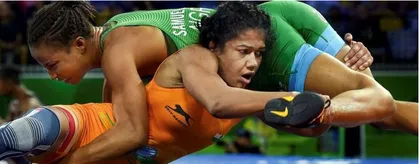
Nigerian wrestlers
Oborududu, Adekuoroye, Genesis, Igali and more.Read more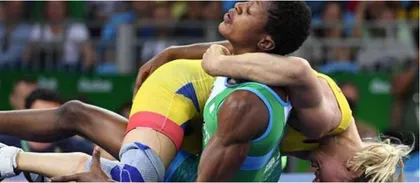
Contact the NWF
How to reach the Nigeria Wrestling Federation.Read more
Quick answers
Wrestling careers in Nigeria: your questions
Can you make a living from wrestling in Nigeria?
Not from a salary: we could find no published salaries for Nigerian wrestlers. Wrestlers are supported by state teams, federation allowances and prizes (such as the ₦25,000 allowance for every registered athlete at the 2026 Governor Diri Wrestling Classics), US college scholarships, and later by coaching and officiating.
How do I start wrestling in Nigeria?
Join your school team or a wrestling club with a qualified coach, then try for your state team. Bayelsa State, home of the national wrestling centre in Yenagoa, and Ondo State have produced many of Nigeria's champions. State officials pick wrestlers for the National Sports Festival and national tournaments.
Can Nigerian wrestlers get scholarships in the United States?
Yes. In July 2026 Esther Kolawole, Christianah Ogunsanya and Adekoye Jumoke moved from William Penn University to Iowa State University, an NCAA Division I school, on wrestling scholarships. Good school results are needed as well as wrestling results.
How do I become a wrestling coach in Nigeria?
Start by helping at a club or school, then take United World Wrestling's free Coach's Education Pathway on the UWW Academy, which runs from Level 1 Foundation Coach to Level 4 Master Coach. UWW ran a Level 3 coaching course in Yenagoa in October 2023.
Is wrestling good for girls in Nigeria?
Yes. Nigeria's women are the country's most successful wrestlers: Blessing Oborududu won Olympic silver at Tokyo 2020, Odunayo Adekuoroye has four World Championships medals, and Nigerian women won all six freestyle golds at the 2023 African Games.
What are the weigh-in rules in wrestling?
Under United World Wrestling rules, wrestlers weigh in on the morning of their competition, with a two-kilo allowance on the second day. The rule was introduced in 2017 to limit extreme weight loss. Young wrestlers should never cut weight without their coach and a doctor.
Who runs wrestling in Nigeria?
The Nigeria Wrestling Federation, inaugurated on 27 September 1981. Its president is Dr. Bashir Adewale Adeniyi, Comptroller-General of the Nigeria Customs Service, elected in October 2025 to succeed Olympic champion Daniel Igali.