Taekwondo · History
History of Taekwondo in Nigeria
From the first Jidokwan school in 1975 to Olympic and world medals.
Advertisement
Our history
History of taekwondo in Nigeria
The introduction of Taekwondo in Nigeria began in the year 1975 by Aikpa Aime from Cote D’ Ivoire, a French-speaking country in the West African Coast. Aikpa was a former student of Grandmaster Kim Yong Tae who is Korea’s pioneer Taekwondo coach in Africa as of 1967.
He opened a school for Jidokwan that same year which was successfully run by three of his black belts named Dominic Bassey, Emmanuel Ikpeme and Kofi Anani. In the year 1976 three American pioneers named Messrs Don Lee, Jerry Parker and Robert Beudon visited Nigeria in different measures introducing the Moo Dukkwan style in Western and Northern Nigeria.
The Moo Duk Kwan School was officially spearheaded by George Ashiru before he later moved to Jidokwan. The Chung Do Kwan School which was also established in Western Nigeria With Mr Deola Kumpayi as the pioneer.
In not less than ten years of establishment, the pioneers of the school and their junior colleagues toiled in a new dimension of establishing one of the most successful martial arts in Nigeria.
The foreign experts that were brought to train the Nigeria Army in the year 1983 and other instructors that came to visit came together to form the Nigeria Taekwondo Black Belt College which later became the Nigerian Taekwondo Association officially recognized in the year 1987 by the Government of Nigeria and the World Taekwondo Federation.
The Chung Do Kwan school expanded on its own with the International Taekwondo Federation as its affiliate as well as the Moo Duk Kwan school which was co-joined with the U.K based World Korean Karate Federation as of the early 1980s and was expanded mainly by the Nigerian universities system through the effort of Master George Ashiru.
In the early 1990s, the members of the Moo Duk Kwan community were selected to join the World Tang Soo Do Association with the leadership of Grandmaster Jae Chul Shin.
It was a thing of celebration and a glorious opportunity for the Moo Duk Kwan community as Tang Soo Do became a notable name again, after gaining acceptance as an Olympic sport when it appeared as a demonstration event in the 1988 Seoul Olympic Games.
Taekwondo became a full medal sports competition at the 2000 Sydney Olympics. Nigerian Taekwondo successfully progressed due to the involvement of the Jidokwan’s Kukkiwon. The sports were made up of a professional team which enhanced the interest of individuals to be part of it.
The sport became a comprehensive art to be adopted by all military forces, schools, private organization and foreign embassies. The interest in Taekwondo sports has recently increased in Nigeria not only as a martial art but as an international sport.
Nigeria has trained athletes who represent them at all international tournaments, African Championships, World Championships, World Cup and the Olympic Games and have won laurels for them.
Verified timeline · checked 30 September 2026
Taekwondo in Nigeria: a timeline
- 1959The Korea Taekwondo Association is founded.
- 1973The World Taekwondo Federation is founded (renamed World Taekwondo in 2017).
- 1975Aikpa Aime from Côte d’Ivoire opens Nigeria’s first Jidokwan taekwondo school.
- 1976American instructors introduce the Moo Duk Kwan style in western and northern Nigeria.
- 1981The Nigerian Taekwondo Association is established.
- 1987Nigeria joins the world federation and wins three golds at the All-Africa Games in Nairobi (Dominic Kim, Anthony Ilukhor, Pius Ilukhor).
- 1992Emmanuel Oghenejobo wins heavyweight silver in the Barcelona Olympic demonstration event.
- 2000Taekwondo becomes a full Olympic medal sport in Sydney.
- 2004Nigeria’s first Olympic taekwondo team fights in Athens.
- 2008Chika Chukwumerije wins Olympic bronze in Beijing (+80 kg).
- 2013George Ashiru becomes federation president and enters the World Taekwondo Hall of Fame.
- 2019Chinazum Nwosu wins African Games gold in Rabat (−53 kg).
- 2024Elizabeth Anyanacho wins African Games gold in Accra and fights at the Paris Olympics.
- 2025Anyanacho wins world championship bronze in Wuxi.
Keep reading
Taekwondo in Nigeria
Kicks, discipline and Olympic medals.Read more
Olympics and African Games
Nigeria’s Olympic medals and African Games results.Read more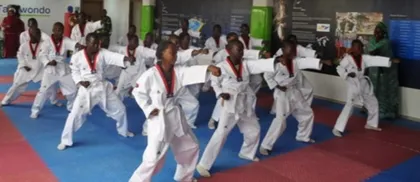
Nigerian taekwondo athletes
Chukwumerije, Anyanacho, Oghenejobo, Ashiru and more.Read more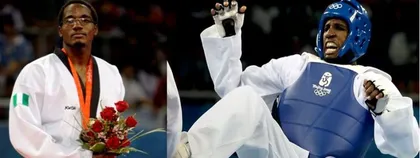
Chika Chukwumerije
Beijing 2008 Olympic bronze medallist.Read more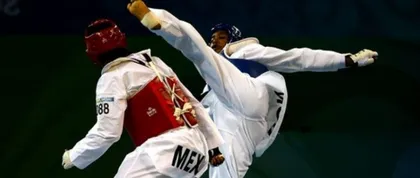
Elizabeth Anyanacho
Two-time Olympian and 2025 world medallist.Read more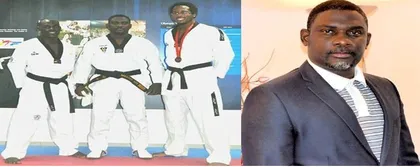
George Ashiru
Champion, Hall of Famer and federation president.Read more
Contact the NTF
Nigeria Taekwondo Federation.Read more
Quick answers
Taekwondo history: quick answers
Who brought taekwondo to Nigeria?
Aikpa Aime from Côte d’Ivoire, who opened a Jidokwan school in 1975; his black belts Dominic Bassey, Emmanuel Ikpeme and Kofi Anani ran it. American instructors introduced the Moo Duk Kwan style in 1976.
What does taekwondo mean?
Tae means foot or kick, kwon means fist or hand, and do means way: the way of the foot and fist.